
"Monarch Methods"
36 article(s) found

A brief introduction to the treatment method of grinding degree and baking degree of Brazilian Hilado coffee beans with sweet and bitter taste
Brazil is vividly compared to the giant and monarch of the coffee world. There are about 3.97 billion coffee trees there, and small farmers now grow 75% of Brazil's total coffee production. The number of coffee producers in Brazil is twice or even three times that of Colombia, the second largest coffee producer in the world. Unlike in the past, Brazil's economy is less dependent on coffee.

A brief introduction to the flavor, taste and aroma characteristics of Brazilian Hilado coffee beans
Serrado field environment in Serrado, in addition to the temperate climate, irrigation facilities enable enterprises to always maintain a stable production supply of quality. In addition, in planting, the balance of the whole environment, spreading herbicides, nourishing weeds that are enough to spread chemical fertilizers, daring to fill the land, harvesting weeds rich in humus, producing coffee trees will be reduced, while the meticulous operation of nature will take the earth-friendly and safe way.

A brief introduction to the description of the flavor, taste and aroma characteristics of Brazilian Hilado coffee beans
The Serrado title is called and you must pass certification testing and production quality. For production, the conditions for the production of so-called project rules (certification area, production area elevation, identification of varieties, best soil, best agricultural technology, in the guaranteed voluntary participation program) have been met, so that if planted in a designated certification, the farm can accommodate signs of Kaseru certification. In addition, quality, shape

A brief introduction to the planting situation of Brazilian Hilado boutique coffee beans, geographical location, climate and altitude
In 2005, due to the first right designated by the Serrado Coffee region in the field of origin certification, the coffee met the standard in this area of production, called Serrado, and claimed that it was recognized. Like wine, coffee producing areas only allow the successful acquisition of world-class coffee regions with limited quality identity, Serrado's name is now known. The Serrado title is called. You must pass the certification.

A brief introduction to the planting situation, geographical location, climate and altitude of the fragrant coffee beans from Hilado, Brazil.
Unlike in the past, Brazil's economy is now less dependent on coffee, which accounts for only 8% to 10% of GDP. Before World War II, Brazil accounted for 50% or more of the world's coffee production, and now it is close to 30%. But the country's impact on the world's coffee, especially on coffee prices, is significant. For example, two frost disasters in 1994 caused global coffee.

A brief introduction to the history and culture of the origin and development of Brazilian Hilado boutique coffee beans.
In 2005, due to the first right designated by the Serrado Coffee region in the field of origin certification, the coffee met the standard in this area of production, called Serrado, and claimed that it was recognized. Like wine, coffee producing areas only allow the successful acquisition of world-class coffee regions with limited quality identity, Serrado's name is now known. The Serrado title is called. You must pass the certification.
A brief introduction to the History and Culture of the Origin and Development of Brazilian Hillado Fine Coffee beans
Serrado field environment in Serrado, in addition to the temperate climate, irrigation facilities enable enterprises to always maintain a stable production supply of quality. In addition, in planting, the balance of the whole environment, spreading herbicides, nourishing weeds that are enough to spread chemical fertilizers, daring to fill the land, harvesting weeds rich in humus, producing coffee trees will be reduced, while the meticulous operation of nature will take the earth-friendly and safe way.

A brief introduction to the treatment method of grinding degree and baking degree of Brazilian Hilado boutique coffee beans with strong flavor
Unlike in the past, Brazil's economy is now less dependent on coffee, which accounts for only 8% of GDP. Before World War II, Brazil accounted for 50% or more of the world's coffee production, and now it is close to 30%. But the country's impact on the world coffee, especially on coffee prices, is very important. for example, two frost disasters in 1994 caused global coffee prices.

A brief introduction to the cultivation of Brazilian Hilado boutique coffee beans with a balanced taste, geographical location, climate and altitude
Since the opening of the free market in 1990, the former Brazilian Coffee Authority (IBC) has been replaced by the National Economic Association, the country's non-investment administrative body, which pursues a policy of non-interference and allows producers to negotiate directly with exporters. The business activities of exporters are supervised by government legislation, and legitimate exporters are registered by the relevant departments, which we have reached today. The Kaseru is established

A brief introduction to the treatment method of grinding degree and baking degree of Brazilian Hilado boutique coffee beans with balanced taste
In 2003, on the basis of the American (SCAA) Special Coffee Association and the conclusion, the coffee SCAA taste type will be promoted to expert agreement, and the exclusion of taste from previous evaluations is now key. Since then, with regard to the assessment of the location at the Serrado Coffee Institute, a certificate has been issued in accordance with the provisions of SCAA Kaseru. In addition, in 2005, taking into account the certificate of origin,

Flavor and taste characteristics of Brazilian coffee beans in different producing areas describe how Brazilian red bourbon coffee varieties are cooked and tasted well
Professional coffee knowledge exchange more coffee bean information please follow the coffee workshop (Wechat official account cafe_style) Brazil is likened to the giant and monarch of the coffee world. There are about 3.97 billion coffee trees there, and small farmers now grow 75% of the country's coffee. Brazil

Introduction to the world's three major coffee producing areas: American coffee estates and detailed explanation of coffee from each producing area
Coffee production in the Americas refers to Central America and South America, and the areas north of Mexico are basically non-producing coffee beans. Coffee production in the Americas is mainly distributed in the Tropic of Cancer to the equator, and several countries in Central America are basically coffee producing countries. Brazil, located in South America, is the world's largest coffee producer. Just like the spread of coffee, it cannot be separated from the era of great navigation.

The Coffee Flavor of Papua New Guinea Coffee beans from major coffee producing countries in the world
Coffee A grown in Indian Coffee Farm India is the first country in Asia to grow coffee, and Indian A-grade coffee beans have always been a kind of coffee strongly concerned by coffee lovers all over the world. Its flavor and taste features: uniform particles, rich taste, slippery and delicious. The cultivation of Indian coffee originated from their colonists, the British. As early as the 17th and early 18th centuries, the British were not like
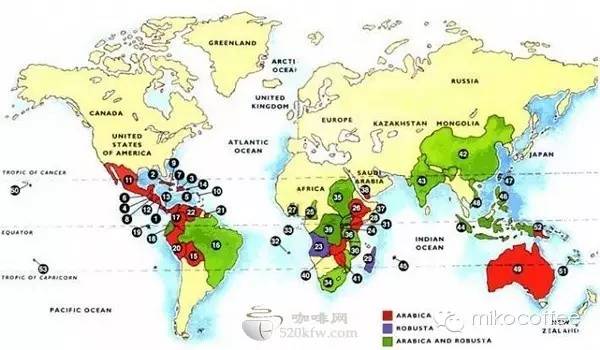
World boutique Coffee beans: the first introduction to Coffee from 53 Coffee producing areas in the World (to be continued)
one. Costa Rican coffee has full grains, ideal acidity and unique strong aroma. Tarrazu of Costa Rica is one of the major coffee producing areas in the world. Costa Rica, with its fertile volcanic soil and good drainage, is the first country in Central America to grow coffee and bananas for commercial value. Coffee and fragrance

There are 25 coffee producers around the world. Let's learn about it together.
Following caf é (Wechat official account vdailycom) found that Beautiful Cafe opened a small shop of its own in the world of bulk trade, in addition to our common soybeans, steel, crude oil, non-ferrous metals and other varieties, there are also many infrequently heard of but also very large trade varieties, such as cocoa, coffee and so on. The word coffee comes from the Greek word Kaweh, which means strength and enthusiasm.
Have a comprehensive understanding of coffee
Legend of Coffee the person who first discovered coffee: a shepherd in Ethiopia, in the fifth and sixth centuries AD. It is said that Niankadi, a shepherd with talent as a poet, herded sheep on the mountain paths of the Ethiopian plateau every day. He liked to drive the sheep home with a shrill flute, but one day the flute sounded again and there was no sign of the sheep. He looked everywhere. Find sheep